
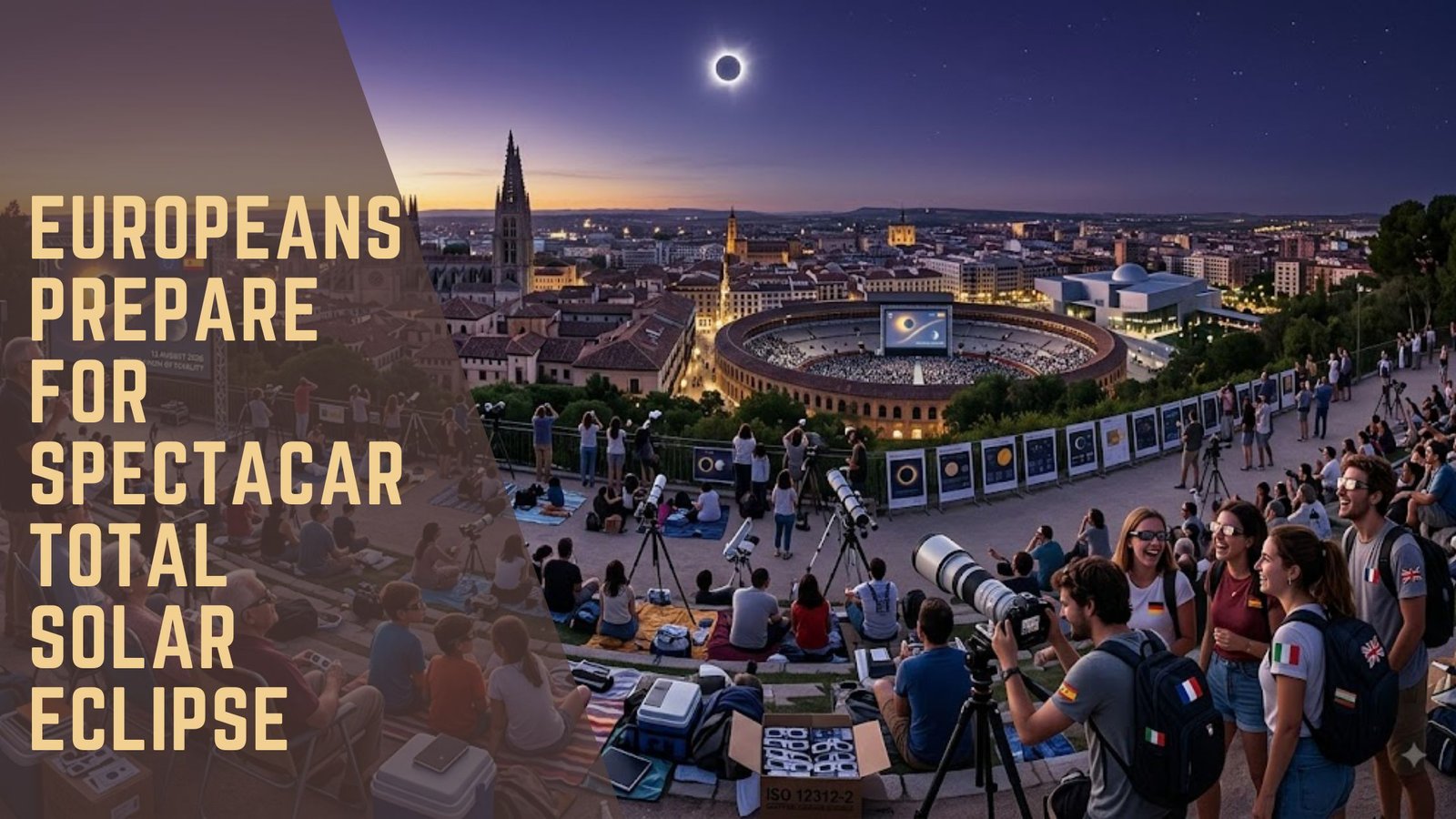

Anticipation Builds for Rare Astronomical Event in Europe
Excitement is reaching a fever pitch across Spain and Iceland as millions gear up to witness a total solar eclipse, a rare celestial event set to captivate observers on Wednesday. Armed with protective eyewear, enthusiasts are flocking to locations where the eclipse will be visible in its entirety, drawn by the promise of a brief but unforgettable transformation of day into night.
Historical and Modern Fascination
The allure of solar eclipses is deeply rooted in human history, often regarded in the past as omens or cosmic battles. Today, the event continues to captivate, offering a chance to experience the mysterious transition from daylight to twilight. As the Moon moves directly between Earth and the Sun, observers are treated to a surreal spectacle that momentarily silences wildlife and transforms the sky.
Juan Cruz, Spain’s Secretary of State for Science, expressed hope that the eclipse would inspire a new generation of astrophysicists. “It’s such a special moment,” he remarked, highlighting the event’s potential to ignite scientific curiosity.
Spain’s Preparedness and Opportunities
Spanish authorities anticipate an influx of up to six million visitors, primarily in rural areas along the eclipse’s path through northern Spain and the Balearic Islands. The timing of the eclipse, just before sunset, enhances its appeal, offering a unique viewing experience. However, with the event coinciding with a high-risk wildfire period, extensive safety measures are in place, including a significant police presence and public awareness campaigns.
The Spanish government also views this as an opportunity to promote less-visited regions, encouraging tourists to explore beyond the crowded coastal resorts. This approach aims to alleviate overtourism and distribute visitors more evenly across the country.
Iceland’s Eclipse Excitement
In Reykjavik, the capital of Iceland, the demand for eclipse glasses has soared, with supplies exhausted days in advance. The Nordic nation, with a population of around 400,000, expects to welcome up to 80,000 visitors eager to experience the eclipse. The path of totality will reach Iceland’s western coast at approximately 5:44 pm local time, with totality lasting just over two minutes in some areas.
The event is expected to cause significant traffic, prompting authorities to advise early arrival for optimal viewing. The occasion has also attracted cultural events, including a DJ set by singer Björk near Reykjavik.
Scientific Exploration and Enthusiast Participation
NASA is leveraging the eclipse for scientific research, deploying a high-altitude WB-57 aircraft from Iceland to trace the Moon’s shadow, while other teams launch balloons to study atmospheric changes during the eclipse.
The event also draws dedicated “eclipse chasers,” enthusiasts who travel the world to witness such phenomena. Gordon Telepun, an amateur astronomer from the United States, plans to observe from Mallorca, citing favorable weather and accessibility as key factors.
Conclusion
With the last total solar eclipse on the Iberian Peninsula occurring in 1912, the upcoming event marks a significant moment in the region’s astronomical history. Another total eclipse is expected in 2027, followed by an annular eclipse in 2028, forming the “Iberian Eclipse Trio.” As millions of eyes turn skyward, the event promises not only a captivating visual display but also an opportunity to inspire and educate future generations.