
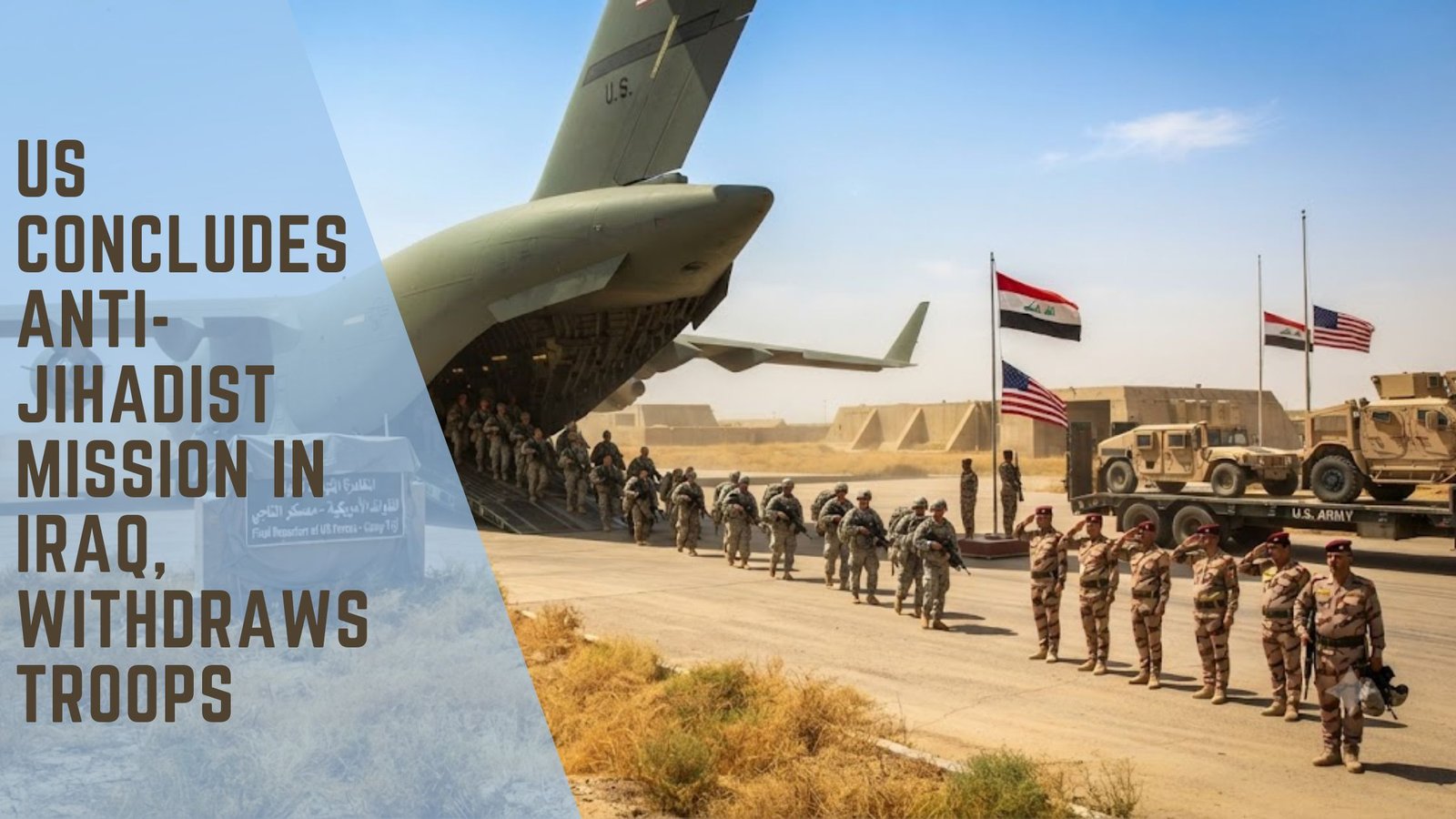

US Declares Formal End to Military Campaign in Iraq
The United States has officially announced the conclusion of its military mission targeting jihadist groups in Iraq, marking a significant shift in its Middle Eastern strategy. This decision follows the strategic withdrawal of American forces from the Erbil airbase situated in the Kurdistan region, as confirmed by the Pentagon on Wednesday.
End of Operation Inherent Resolve
After more than a decade of engagement, the US-led coalition has decided to terminate its operations against the Islamic State (IS) group in Iraq and the neighboring Syria. The coalition, which initially aimed to combat the territorial expansion and humanitarian atrocities committed by IS, had achieved significant milestones with the liberation of occupied territories in Iraq by 2017 and in Syria by 2019.
Despite these victories, coalition forces remained in the region to address the ongoing threat posed by IS remnants. However, recent developments have led to a decision to conclude Operation Inherent Resolve, a mission central to US and coalition efforts in the region.
Official Statement and Strategic Implications
In an official statement, Sean Parnell, the Pentagon’s chief spokesperson, articulated the conclusion of the operation as consistent with the US-Iraq joint statement of September 2024 and aligned with broader US national interests. He noted, “Today, the United States and our Coalition partners formally concluded Operation Inherent Resolve in Iraq.”
The statement underscored the significance of the orderly withdrawal of coalition forces and equipment from the Erbil Air Base, signifying the successful closure of the military campaign that dismantled IS’s grip in Iraq.
Gradual Withdrawal and Regional Dynamics
The decision to wind down the coalition’s mission was mutually agreed upon by Baghdad and Washington in 2024, leading to a phased withdrawal of troops from various military bases throughout Iraq. The presence of coalition forces was subsequently limited to the autonomous northern Kurdistan region, reflecting a strategic recalibration of US military involvement in the region.
This withdrawal is perceived by the Iraqi government as a pivotal move, potentially reducing the justification used by powerful Iran-backed militant factions to maintain their armed presence within the country.
Future Prospects and Regional Stability
The conclusion of the US mission in Iraq raises questions about the future of regional stability and the potential resurgence of jihadist elements. The Iraqi government, alongside regional allies, faces the challenge of maintaining security and preventing the re-emergence of extremist threats.
Analysts suggest that the withdrawal could lead to a realignment of power dynamics within Iraq, as well as impacting relations with neighboring countries. The void left by coalition forces might be filled by other regional players, necessitating a nuanced approach to maintaining peace and security.
Conclusion of an Era
The formal conclusion of the US mission against jihadists in Iraq marks the end of a significant chapter in the region’s recent history. As the US recalibrates its foreign policy and military engagements, the focus now shifts to diplomatic efforts and regional partnerships aimed at ensuring long-term stability.
As the Iraqi government navigates this transitional phase, the international community remains watchful of the implications for both Iraq and the broader Middle East.